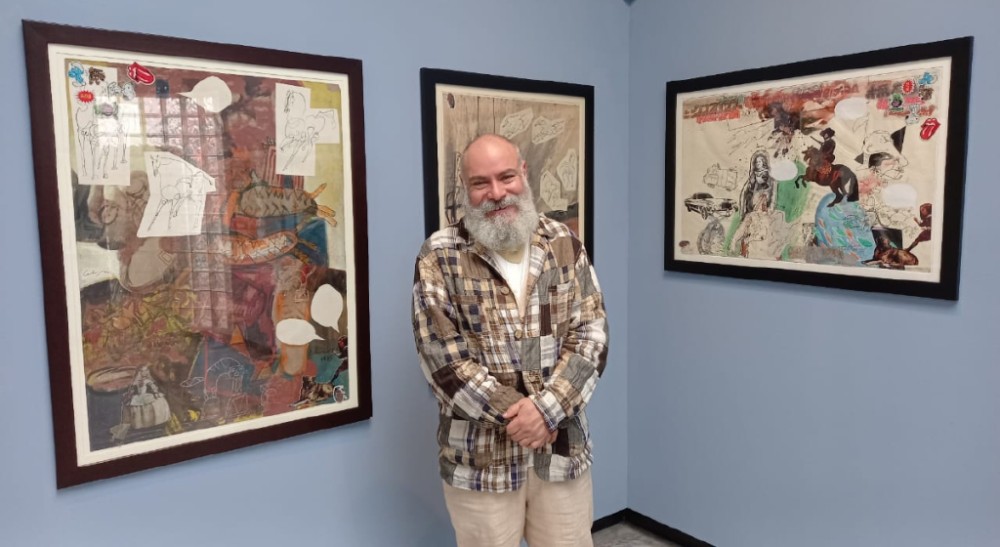
This is no ordinary exhibition. It was born out of misfortune and chance, transforming magical surrealism into something tragic—filled with irony, sarcasm, and reflection. It is a show that had to wait 40 years to be completed and exhibited, one that pokes fun at artistic purism by presenting viewers with works in which a wide range of techniques converge alongside the distinctive style of each of its three creators.
The exhibition is "Tragic Realism: 40 Years Trapped in Time," by Armando Romero, Ricardo del Río, and Rafael Charco, which opened last night at Lux Perpetua Gallery alongside a solo exhibition by Romero entitled "Portraits of Portraits." The latter revisits the likenesses of celebrated painters such as Rembrandt and Leonardo da Vinci, reproducing and intervening in their portraits to give them meanings far removed from the originals.
Speaking about "Tragic Realism: 40 Years Trapped in Time," Armando Romero shared the remarkable story behind its origins. As he, Ricardo del Río, and Rafael Charco were about to graduate from La Esmeralda National School of Painting, Sculpture and Printmaking in Mexico City, they proposed as their final project the creation of 50 drawings based on a critique of the artistic atmosphere surrounding them, at a time when everyone seemed to be producing magical realism.
To explain their point, Romero recalls an anecdote from the 1940s. Writer André Breton commissioned a Mexican carpenter to build a table, "the talking table" from a design Breton himself had drawn. The sketch was intended to show the table in three dimensions so the carpenter could understand the shape of its legs. Instead, the carpenter built the piece exactly as it appeared in the drawing, resulting in a table that could not stand on its own.
Breton then declared that Mexico was a surrealist country par excellence, and artists eagerly embraced the label.
Romero, however, argues that this was not magical realism but tragic realism. When something like that happens to a carpenter, a plumber, or a mechanic, he says, it is simply what it is.
He explains that when the three artists proposed the project as their thesis, strict academic rules prohibited printmakers from incorporating painting into their work, or painters from using printmaking or any other technique. They rejected that kind of artistic purism.
Their proposal was accepted, and they began working together—literally with six hands. Every piece bears the intervention of all three artists.
They had completed 42 works, lacking only a few finishing touches, when the devastating 1985 Mexico City earthquake struck. The artworks disappeared, and they had no idea where they had ended up. To graduate, each artist had to complete an individual project instead.
Life went on, and so did their artistic careers…until last year. While moving a cabinet that had belonged to Ricardo del Río's grandfather, they heard something fall from behind it. It turned out to be the portfolio containing the works they had created as young art students.
The unexpected discovery reunited the three longtime friends, who set out to complete the unfinished works, almost like remastering an old recording and finally give the project the public presentation it had been denied four decades earlier.
Romero compares the creative process to a progressive rock band. Rafael Charco created the atmospheric backgrounds—the equivalent of the drums. Ricardo del Río contributed the lead guitar, represented by his masterfully drawn horses, executed in a single uninterrupted line without lifting the pen from the paper. Romero describes himself as the composer, responsible for assembling the final composition. The resulting works juxtapose the earthly and the celestial, incorporating Baroque elements alongside speech bubbles, sometimes left blank, at other times delivering sharp social commentary through concise, powerful phrases.
The 42 works on display bring together three dimensions: the figurative, the abstract, and the pragmatic.
Because they were finally completed only last year, each piece bears two signatures—a tangible reminder of fate's strange intervention, which forced the artists to wait 40 years before bringing the project to completion.
In the same gallery, Armando Romero is also presenting "Portraits of Portraits", a series of miniature paintings that revisit the likenesses of renowned artists. He plays not only with the images themselves adding phrases, brushstrokes, and collage, but also with the frames, embellishing them with small gilded sculptures in a style reminiscent of the Baroque.
It employs the same mixed-media approach as the collaborative exhibition, although expressed through different forms of representation.
Both exhibitions will remain on view at Lux Perpetua Gallery through the end of February. Visiting hours are Monday through Friday from 10:00 a.m. to 2:00 p.m. and 4:00 p.m. to 7:00 p.m., and Saturdays from 10:00 a.m. to 2:00 p.m. Visits at other times are available by appointment through the gallery's Instagram account. — Iris Ceballos Alvarado