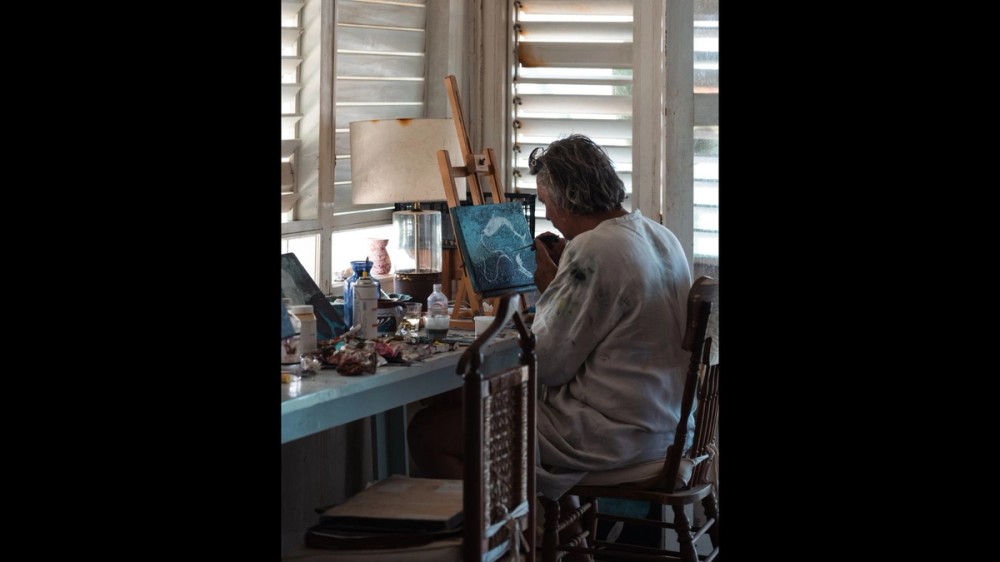
"Art imitates nature," Aristotle wrote. This does not mean that the artist is devoted to the mere reproduction of the creatures of the world. Rather, art seeks to imitate the way nature does things. The work of Guillermo Olguín (Mexico City, 1969) exemplifies this pursuit. Here, the craft of image-making is shaped by a central enigma: How does nature create beauty?
In the Aristotelian tradition, art (technē) is understood as a practice. The artist develops a unique intuition for deciphering mysteries, revealing knowledge through the use of color, texture, the interplay between the figurative and the abstract, and the realm of imagination. The choice of formats and materials unfolds organically. Landscapes emerge with effortless naturalness, and the result is striking: the images themselves seem to possess life.
Olguín has presented his work in more than thirty solo and group exhibitions across Mexico, the United States, Hungary, Cuba, Paraguay, Brazil, Argentina, Italy, England, Germany, Spain, Portugal, France, Finland, and Japan. During the past year, he stepped away from the fast-paced art market in order to concentrate on producing a substantial body of work and assembling an exhibition of varied formats. Omens invites viewers into a world inhabited by living beings moving through fantastical settings: nights, seas, light, depths, dreamlike landscapes, unreal atmospheres, journeys, and memories. It is a world that unfolds according to its own sense of time. Every scene hints at a story waiting to be discovered.
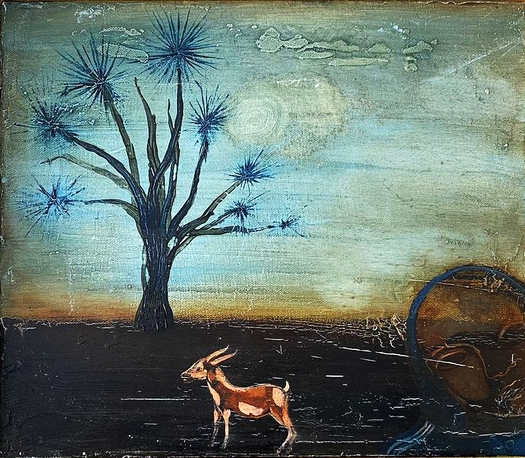
An omen is the sign of something yet to come. It arises from subtle signals, premonitions, and intuitions. It is something fleeting—a narwhal gliding through a dark ocean, or a luminescent tree glowing in the night. Through oil paint, canvas, wood, and jute, Omens reveals a living universe, reminding us of what art can learn from nature.